“The Freedom Show (2026): When Late Night Stops Joking and Starts Recording History”
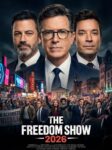
In a media landscape built on punchlines and applause cues, The Freedom Show (2026) arrives like a held breath—deliberate, unsettling, and impossible to ignore. Framed as a political thriller disguised as a broadcast experiment, the film imagines a near-future where America’s most recognizable late-night figures step away from the safety of comedy and into something far more dangerous: documentation.
The story centers on Stephen Colbert, portrayed not as a host chasing relevance, but as an architect dismantling the very format that made him famous. In the film’s opening act, Colbert grows conspicuously silent. Monologues soften, jokes vanish, and the studio laughter fades. What appears at first to be burnout becomes something else entirely—a strategic withdrawal. Behind closed doors, conversations begin. Quiet ones. Urgent ones.
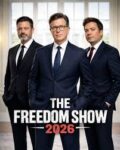
Soon, the film reveals an unprecedented alignment: Colbert, Jimmy Kimmel, and Jimmy Fallon—three hosts from rival networks—meeting in secrecy. Not to negotiate contracts or share airtime, but to build a project without a network at all. The working title, whispered among producers, is The Freedom Show.
Director and tone suggest restraint rather than spectacle. The upper half of the film’s visual language is dominated by faces—controlled, unsmiling, resolute. Colbert stands at the center, flanked by Kimmel and Fallon, their expressions stripped of performative warmth. These are not entertainers waiting for applause. They are witnesses preparing testimony.
The lower half of the narrative erupts into motion. Protests spill through city streets. News tickers blur. Crowds raise fists beneath flickering billboards. Investigative segments unfold with on-screen documents, timelines, and unfiltered footage. There are no ironic cutaways, no musical stings to soften the blow. The film insists that satire, when sharpened enough, becomes a weapon.
Set during an election year, The Freedom Show explores a fractured trust between the public and the media meant to inform it. The hosts’ decision to abandon fixed schedules and network branding becomes the film’s most radical idea. Episodes appear only when “silence itself becomes part of the story,” turning absence into commentary and timing into accusation.
What unsettles most is what the film withholds. A sealed element—something tied directly to Colbert—remains unrevealed until the final act. Its nature is less important than its implication: that late night, long dismissed as entertainment, may have been one of the last places capable of telling the truth precisely because it was never expected to.
The Freedom Show (2026) is not a celebration of rebellion, nor a call to outrage. It is colder than that. It asks what happens when the joke is no longer enough, when laughter becomes complicity, and when the people best trained to speak every night decide instead to speak only when it matters.
By the time the credits roll, the question lingers uncomfortably in the dark: if this is what late night could be, why did it take so long to arrive—and who benefits when it disappears again?